

 Sphynx | Ismail Larhrib



484 words
2 minutes
1337 Local CTF — DFIR Track Architecture & Solutions
1337 Local CTF — DFIR Track Architecture & Solutions
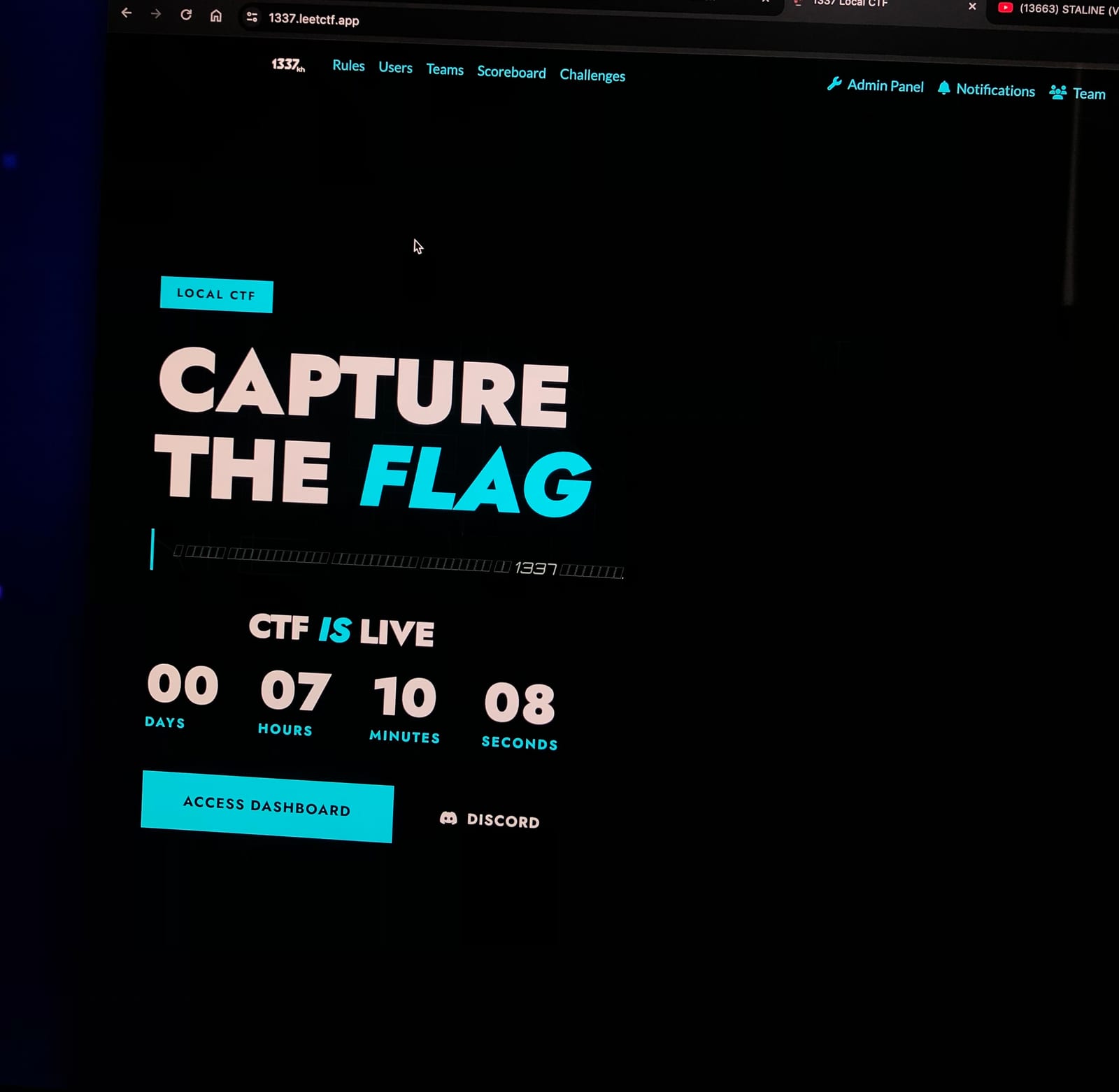
Organized by Ismail Larhrib (Sphynx) alongside fellow members of Team MIR4GE, the 1337 Local CTF was an internal competition hosted for the student and security community at 1337 Coding School (UM6P / 42 Network).
The DFIR (Digital Forensics & Incident Response) track was designed to simulate realistic defensive and forensic workflows rather than artificial CTF puzzles.
- Official Repository: github.com/NotSphyynxx/1337-local-ctf
- Organizers: Team MIR4GE Core
Challenge Matrix
| # | Challenge | Focus Area | Difficulty | Points |
|---|---|---|---|---|
| 01 | Traffic & Forensics Analysis (Tbrgig) | Network Forensics & Web Triage | Easy | 100 |
| 02 | The Encrypted Callback | TLS 1.3 Decryption & XOR Streams | Hard | 300 |
| 03 | Inception | .NET Malware & Anti-Analysis Reversing | Hard | 400 |
| 04 | The CNSS Phish | RFC 822 Email Headers & Deobfuscation | Medium | 200 |
| 05 | The Boss Level | End-to-End Enterprise Breach Investigation | Extreme | 500 |
Challenge Writeups
01 — Traffic & Forensics Analysis (Tbrgig)
- Scenario: SOC sensors detected port reconnaissance and anomalous HTTP requests against an internal server (
10.0.0.10). - Investigation Steps:
- Filtered for ICMP sweeps and TCP SYN scans in Wireshark to establish the attacker IP.
- Identified directory traversal attempts targeting Apache configuration and leaking
.env. - Carved the transferred ZIP archive (
bocal.zip) directly from HTTP payload streams. - Used
binwalkto uncover and extract trailing steganographic bytes appended to the archive.
- Flag:
leet{W1r3sh4rk_k1wsl_lh4dr4_lmz47a}
02 — The Encrypted Callback
- Scenario: EDR triggered on suspicious in-memory PowerShell execution. Active TLS session keys were extracted from LSASS memory (
sslkeylog.log). - Investigation Steps:
- Configured Wireshark (
(Pre)-Master-Secret log filename) with the dumpedsslkeylog.logto decrypt TLS 1.3 encrypted payloads. - Extracted and decoded a Base64 UTF-16LE encoded PowerShell dropper script.
- Unpacked stage 2 AES-CBC encrypted binaries from the decrypted HTTP conversation.
- Reverse-engineered a 4-layer obfuscated exfiltration algorithm (
Base64 -> Reverse -> Hex -> XOR).
- Configured Wireshark (
- Flag:
leet{Waaaaa_tchhbaarklaah}
03 — Inception (.NET Dropper Reversing)
- Scenario: Finance department targeted by a suspicious binary disguised as
invoice.exe. - Investigation Steps:
- Loaded
invoice.exeinto dnSpy / ILSpy for C# decompilation. - Identified and bypassed anti-analysis routines (
Debugger.IsAttachedand anti-VM timing loops). - Located encrypted embedded resource streams (
enc_payload.bin) reflectively loaded viaAssembly.Load(). - Reverse-engineered the rolling XOR key schedule implemented in the dynamically invoked assembly.
- Loaded
- Flag:
leet{n3t_r3fl3ct10n_m4lw4r3_r3v3rs1ng}
04 — The CNSS Phish
- Scenario: Targeted spear-phishing campaign impersonating national social security (CNSS) security advisories.
- Investigation Steps:
- Parsed RFC 822 email headers (
.eml), verifying SPFSoftFailflags and tracing intermediateReceived:gateway hops. - Extracted the true adversary relay IP (
198.51.100.42), which served as the archive extraction key. - Unzipped the password-protected document attachment containing phishing credential harvesting scripts.
- Deobfuscated hexadecimal string escapes in JavaScript to expose the exfiltration backend and capture flag.
- Parsed RFC 822 email headers (
- Flag:
leet{Bghaw_idrbo_lina_cnss_(ra_derboha)}
05 — The Boss Level (Full-Spectrum Incident)
- Scenario: A simulated advanced persistent threat (APT) intrusion scenario involving weaponized phishing lures, encrypted stage delivery, sandbox evasion, and dynamic C2 memory beacons.
- Investigation Steps:
- Correlated email lure headers with packet capture (
capture.pcap) sessions. - Extracted the multi-part encrypted payload
invoice.encover anomalous HTTP ports. - Derived the XOR key from the lure staging script and decrypted the raw payload.
- Decompressed Base64 + zlib Python loaders and patched out virtual environment detection hooks.
- Decrypted runtime memory structures containing the primary C2 command server and master flag.
- Correlated email lure headers with packet capture (
- Flag:
leet{hlkk_Ai_awled_3ami}
Recommended Tooling
- Network Forensics: Wireshark, TShark, NetworkMiner, Zeek
- Malware Analysis & Reversing: dnSpy, ILSpy, Ghidra, x64dbg, CyberChef
- Log & Header Triage: EML Analyzer, Volatility 3, Sysmon, Splunk
Credits & Organization
- Event: 1337 Local CTF (42 Network)
- Organizers: Sphynx & Team MIR4GE
- DFIR Challenges & Architecture: Ismail Larhrib (Sphynx)
- Repository: NotSphyynxx/1337-local-ctf